
Turn article assumptions into a first actuator family, model class, and evidence request.
Open catalog RFQ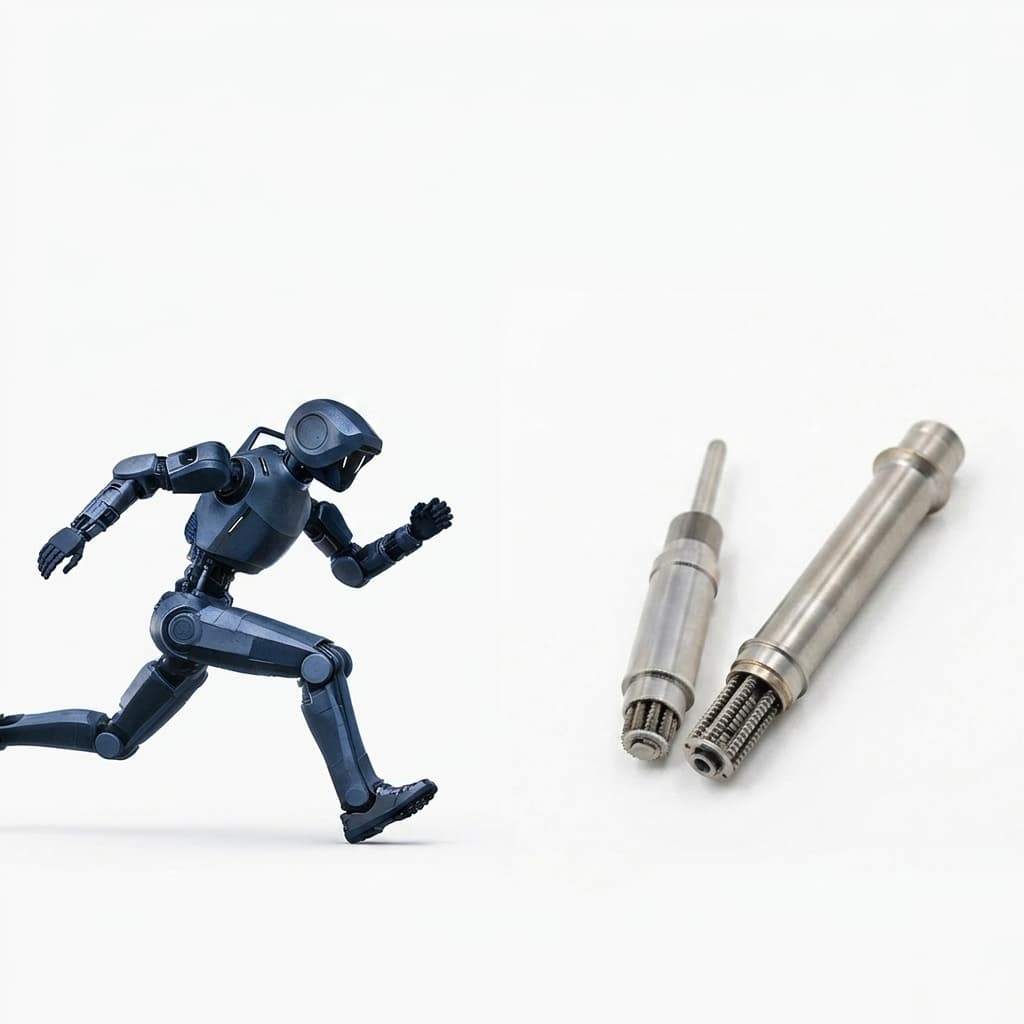
2026/10/26
Planetary Roller Screws vs. Ball Screws for Humanoid Linear Actuators: A 2026 Sourcing & Engineering Guide
Compare planetary roller screws vs ball screws for humanoid linear actuators. Check loads, packaging and supplier evidence, then prepare your engineering RFQ.
Quick answer: Compare planetary roller screws vs ball screws against the same joint load spectrum and complete actuator envelope. Shortlist roller screws when a ball-screw candidate cannot meet the required load rating, stiffness or package. Choose an inverted planetary roller screw (IPRS) when its motor-and-nut integration improves that package. Keep a ball screw on the shortlist when it meets the duty cycle with acceptable cost and validation effort; neither architecture is automatically suitable for every humanoid knee.
Published and reviewed: October 26, 2026. Scope: Global, English-language engineering and procurement guidance for electromechanical humanoid linear actuators. This is a source-based design review, not an in-house hardware test, supplier endorsement or current price survey. Calculations below are illustrative screening examples. Final ratings, delivery dates and maintenance intervals require a model-specific supplier submission and application validation. Review again before a design freeze or supplier change.
For hardware engineering leads and procurement managers, the useful decision is not “which screw is best?” but “which assembly meets our force, speed, life and packaging requirements with evidence we can accept?” The comparison table, failure-mode review and RFQ checklist below turn that question into a supplier evaluation.
Start with our Humanoid Linear Actuator Product Overview to compare integration requirements, or use the High-Torque Leg Actuator Modules page for lower-body sourcing context.
1. Why Linear Actuation in Humanoids?
A linear actuator can drive a knee, ankle or hip linkage through a variable moment arm. Its advantage depends on the linkage geometry: a small effective moment arm can demand a large axial force even when joint torque is moderate. Map that geometry across the full range of motion rather than sizing from robot body mass alone.
Published research demonstrates one implementation, not an industry-wide architecture mandate. The abstract of Lin et al.'s roller-screw knee-joint study describes kinematic modeling, simulation and deployment on hardware using position control for the linear knees. It supports evaluating roller-screw knees as a design option; it does not establish a universal shock limit or lifetime advantage over ball screws.
A reproducible lead, torque and speed screen
Assume one actuator carries 6,000 N, moves at 0.10 m/s, and has an effective moment arm of 0.040 m. Treat these as a hypothetical design point, not measured humanoid loads. For a direct motor-to-screw drive, use forward efficiency 0.85 for both candidates solely to isolate the effect of lead; this is not a claimed efficiency for either screw type.
| Screening quantity | Equation and units | 2 mm/rev lead | 5 mm/rev lead |
|---|---|---|---|
| Joint torque at this pose | Torque = axial force × perpendicular moment arm | 240 N·m | 240 N·m |
| Motor torque, steady driving | T = F × lead / (2π × efficiency), lead in metres/rev | 2.25 N·m | 5.62 N·m |
| Screw speed | n = 60 × linear speed / lead, lead in metres/rev | 3,000 rpm | 1,200 rpm |
| Mechanical input power | P = F × linear speed / efficiency | About 706 W | About 706 W |
A smaller lead reduces required steady torque while increasing rotational speed. These equations omit acceleration, preload drag, seals, bearings and motor/inverter losses. Check the motor torque-speed curve, thermal duty and screw speed limits separately. The calculation establishes neither fatigue life nor safe landing loads, and the assumed force and speed need not occur simultaneously in a real gait.
2. Contact Mechanics: Ball Contacts vs. Threaded Roller Contacts
A ball screw transmits axial load through balls contacting the screw and nut raceways. A planetary roller screw uses multiple threaded rollers. Both carry load through finite, stressed contact patches; an unloaded geometric “point” is not an infinitesimal loaded area, and crowned roller threads are not guaranteed to produce perfect rectangular line contacts.
Rollvis's product overview identifies planetary, inverted, recirculating and differential roller-screw families, including compact integrated constructions. This supports comparing real configurations rather than treating all roller screws as one interchangeable product.
Roller screws can offer useful load capacity within a constrained envelope, but there is no universal contact-area, load-rating or life multiplier. Compare named part numbers with their nut length, lead, preload and support arrangement disclosed:
- Dynamic load rating: Use the manufacturer's rating definition and fatigue-life method with the actual load spectrum, travel and reliability requirement. Do not apply one life exponent to every screw family without checking its calculation convention.
- Static load rating: Assess the maximum equivalent load and the supplier-agreed static safety factor. A static rating is not permission to exceed that rating during an impact.
- Whole-assembly capacity: Thrust bearings, screw buckling, end connections and housing stiffness can limit the actuator before the screw contact rating does.
The diagram is a conceptual view of the load paths. It contains no measured or calculated stress values and must not be used to approve an impact load.
3. Standard Planetary Roller Screw vs. Inverted Planetary Roller Screw (IPRS)
Standard planetary roller screw (PRS)
In a conventional arrangement, the long externally threaded screw engages rollers within a shorter nut. Depending on the design, the screw can rotate and the nut translate, or the nut can rotate and the screw translate. Compare both drive arrangements before assuming that a conventional screw requires an end-mounted motor.
Inverted planetary roller screw (IPRS / reverse roller screw)
An inverted arrangement uses a long internally threaded nut and a shorter active screw/roller engagement region. An actuator may rotate the nut while an anti-rotated central rod translates. This can allow the motor to surround the nut, but the exact roller retention, bearings and output-rod arrangement depend on the supplier design.
LTK's inverted roller-screw overview describes customized humanoid applications and dedicated thread-grinding capability. It supports the compact-integration rationale, not a guaranteed percentage reduction in length or inertia.
Conceptual inverted arrangement — one possible integration

Housing and motor stator
    Motor rotor coupled to rotating long nut
        Internally threaded nut + roller engagement region
            Guided output rod translates toward the joint clevis
    Thrust bearings, seals and anti-rotation guidance still required
Packaging trade-offs to verify
- Retracted and extended length: Include rod ends, usable stroke, end stops, bearings, seals and wiring. Motor overlap can reduce length; it does not eliminate dead length.
- Rotating inertia: A long nut rotating at a larger radius may have substantial inertia. Request the rotating assembly inertia and evaluate it with the chosen lead.
- Motor integration: Check the rotor-to-nut connection, runout, bearing preload and differential thermal expansion. A matching nominal diameter alone does not define a suitable fit.
- Heat rejection: Review motor losses, screw drag and bearing heat in the assembled housing. Compact packaging does not prove adequate continuous thrust.
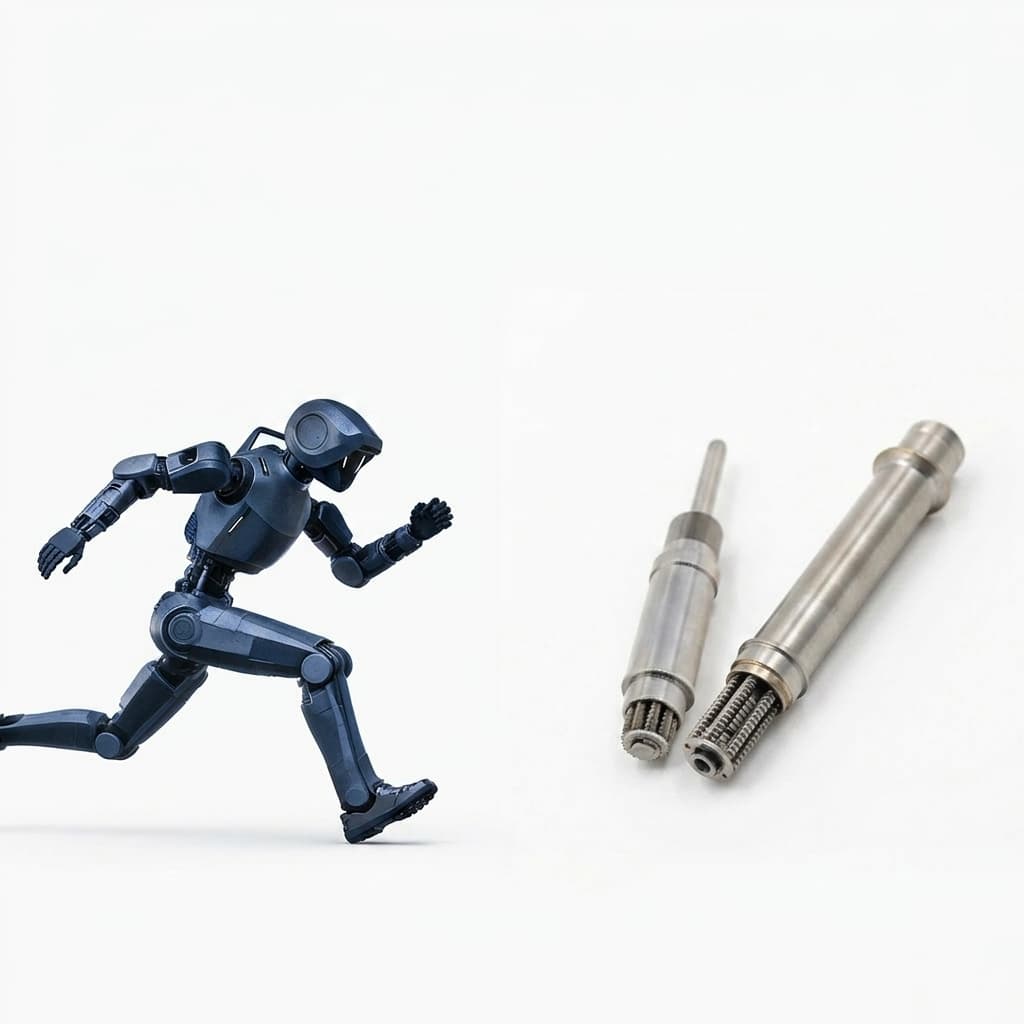
Existing product illustration for orientation; not a section drawing, measured sample or dimensional acceptance reference.
4. Engineering Comparison: Ball Screw vs. PRS vs. Inverted PRS
This is a qualitative screening table, not a specification sheet. Obtain matched part-number data for the same force, speed, travel, temperature, life and package requirements before ranking suppliers.
| Parameter / Metric | Precision Ball Screw | Standard Planetary Roller Screw (PRS) | Inverted Planetary Roller Screw (IPRS) | Sourcing / Design Takeaway |
|---|---|---|---|---|
| Load-carrying elements | Recirculating balls | Multiple threaded rollers | Threaded rollers in an inverted arrangement | Contact layout alone cannot establish capacity. |
| Dynamic load rating | Depends on model, diameter and nut configuration | Can offer high capacity in a constrained envelope | Depends on the particular inverted design | Request ratings and the applicable fatigue-life calculation. |
| Static load and impact | Can suffer permanent indentation under overload | Can also suffer indentation or other overload damage | No inherent immunity to impact damage | Check maximum equivalent loads and validate the complete assembly. |
| Lead options | Fine and coarse leads exist, depending on size | Lead range depends on the roller-screw family | Small-lead options may support compact integration | Calculate both motor torque and rpm; verify catalog availability. |
| Axial stiffness | Includes ball contacts, screw and support stiffness | Depends on contacts, preload and shaft/support stiffness | Nut, bearings and housing contribute to total stiffness | Request an assembled force-deflection curve. |
| Rotational speed | Limited by the selected nut, shaft and supports | Limited by selected geometry, lubrication and supports | Rotating nut and bearings require their own speed checks | Check critical speed where applicable and the vendor speed limit. |
| Retracted envelope | Depends on rotating member and drive arrangement | Can use a rotating screw or nut | Motor may overlap the long nut | Compare complete CAD envelopes including stroke and end connections. |
| Backdrivability | Depends on lead, friction, seals and preload | Depends on the same assembled-system factors | Small lead can increase required backdrive force | Measure reverse-drive behavior; define brake and power-loss requirements. |
| Backlash and preload | Clearance and preloaded versions exist | Preload changes drag and stiffness | Assembly-specific clearance/preload options | Specify a reversal measurement under defined load and temperature. |
| Cost basis | Compare standard and custom candidates | Request component, tooling and acceptance-test costs | Internal nut machining and integration can affect cost | Compare quotations on the same quantity, currency and Incoterm. |
| Lead-time basis | Confirm stock and customization separately | Confirm tooling, first article and batch slots | Confirm long-nut manufacture and integration milestones | Use a dated supplier commitment rather than a generic weeks range. |
Fine leads are not exclusive to roller screws. THK's shaft-diameter and lead tables include small-lead ball-screw combinations. Confirm the particular diameter/lead combination instead of assuming that every ball screw starts at a 4 mm lead.
If a bare-screw comparison leaves the bearing or motor interface unresolved, use the integrated linear actuator overview to prepare an assembly-level RFQ.
5. Critical Failure Modes in Humanoid Service
These are engineering risks to assess, not findings from an in-house teardown or a claim that all humanoids experience them.
1. Permanent indentation and impact overload
Landing, end-stop contact and collision loads can exceed normal gait loads. Both screw types can suffer permanent damage. Specify a load-time history and load path, then agree the static margin and overload test with the supplier. Inspect reversal error, drag torque and running noise before and after the test. Do not infer “no brinelling” from a screw-type label or a fixed multiple of the dynamic rating.
2. Roller synchronization and ball-return damage
Roller-screw timing components and ball-screw return components are different mechanisms with different failure risks. Require the supplier to identify its synchronization or recirculation arrangement, permitted acceleration and alignment requirements. Review abnormal drag, contamination and collision cases without assuming a particular failure sequence for every design.
3. Lubrication under short-stroke oscillation
Small repeated motions can challenge grease redistribution in either architecture. Specify stroke amplitude, frequency, axial load, temperature and dwell time for an endurance test. Request a supplier-approved lubricant, seal compatibility and relubrication plan; neither a generic grease additive nor a “lubricated for life” label establishes life under humanoid duty.
4. Thermal preload and alignment changes
Motor and transmission losses heat the nut, shaft, bearings and housing differently. Changes in expansion and alignment can raise drag or alter preload. Measure starting/running torque and reversal error from cold start through thermal steady state. Acceptance requires the motor's continuous torque margin at the actual operating temperature.
6. Manufacturing Economics & Sourcing Realities in 2026
As of the October 26, 2026 review, this guide has no auditable supplier quote set or production-yield dataset. It therefore gives no global price band, BOM percentage, manufacturing-yield trend or standard delivery-time promise. A country of manufacture is not a proxy for capability.
The grinding and inspection questions
For a custom inverted screw, ask which thread features require dedicated tooling, which operations are in-house, and how the long internal nut thread is finished and inspected. Do not require one universal steel, heat-treatment route or grinding process without reference to the approved design.
Request the supplier's accuracy class and standard edition, measured characteristics, inspection length and report format. A C-grade designation or a single lead-deviation figure is not a complete stiffness, backlash or service-life specification.
Build a comparable sourcing quote
Use one drawing revision and load-spectrum attachment for every candidate. The quote should separate:
- Bare screw/nut assembly, thrust bearings, motor, sensors, brake, housing and seals, with explicit inclusions and exclusions.
- Prototype quantity, pilot quantity and annual-volume pricing, currency, Incoterm, freight and taxes.
- Non-recurring engineering (NRE), tooling ownership, inspection fixtures and change charges.
- Tooling completion, first-article inspection, application test, pilot acceptance and repeat-batch delivery milestones.
- Quote date, validity period, capacity reservation and a recovery plan if a milestone slips.
Buying an integrated actuator can place bearing alignment and sealing within the supplier's scope. Verify that the contract actually assigns those requirements and tests; integration does not itself prove qualification.
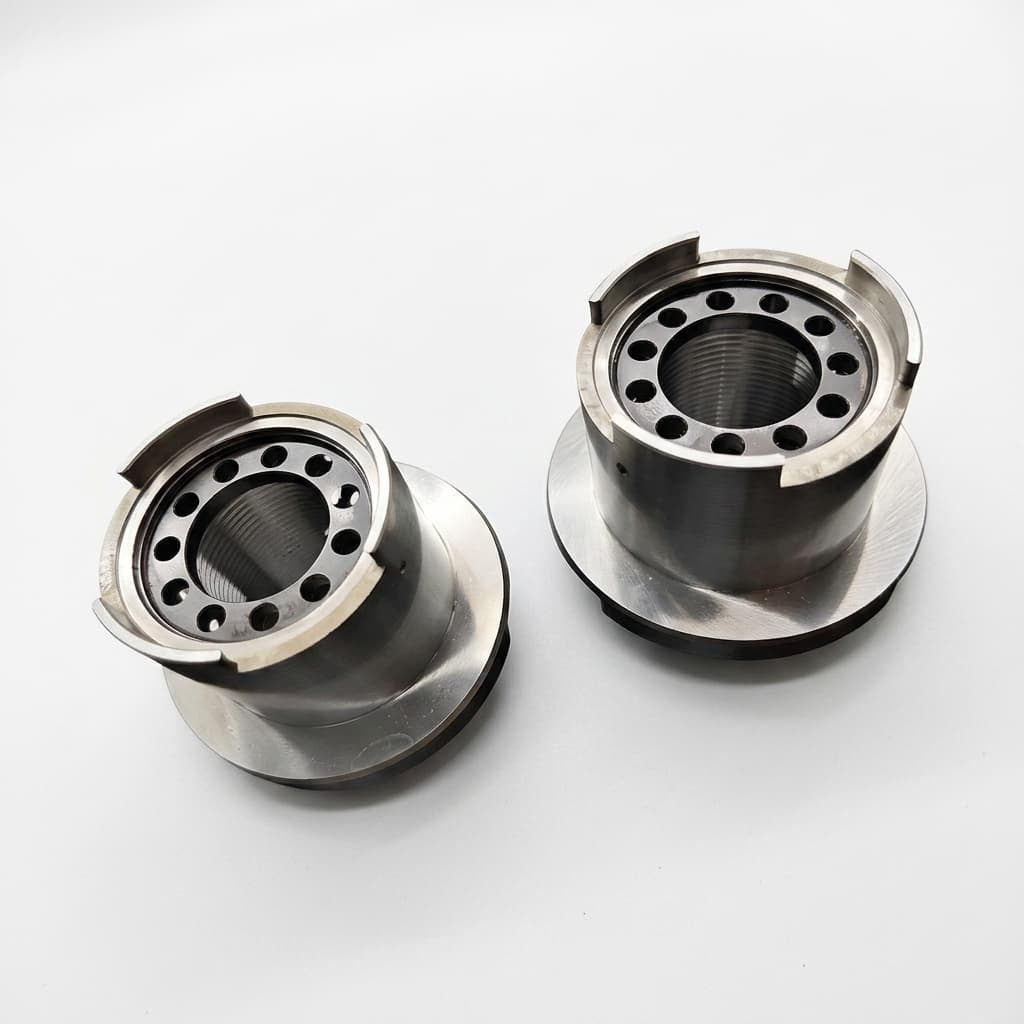
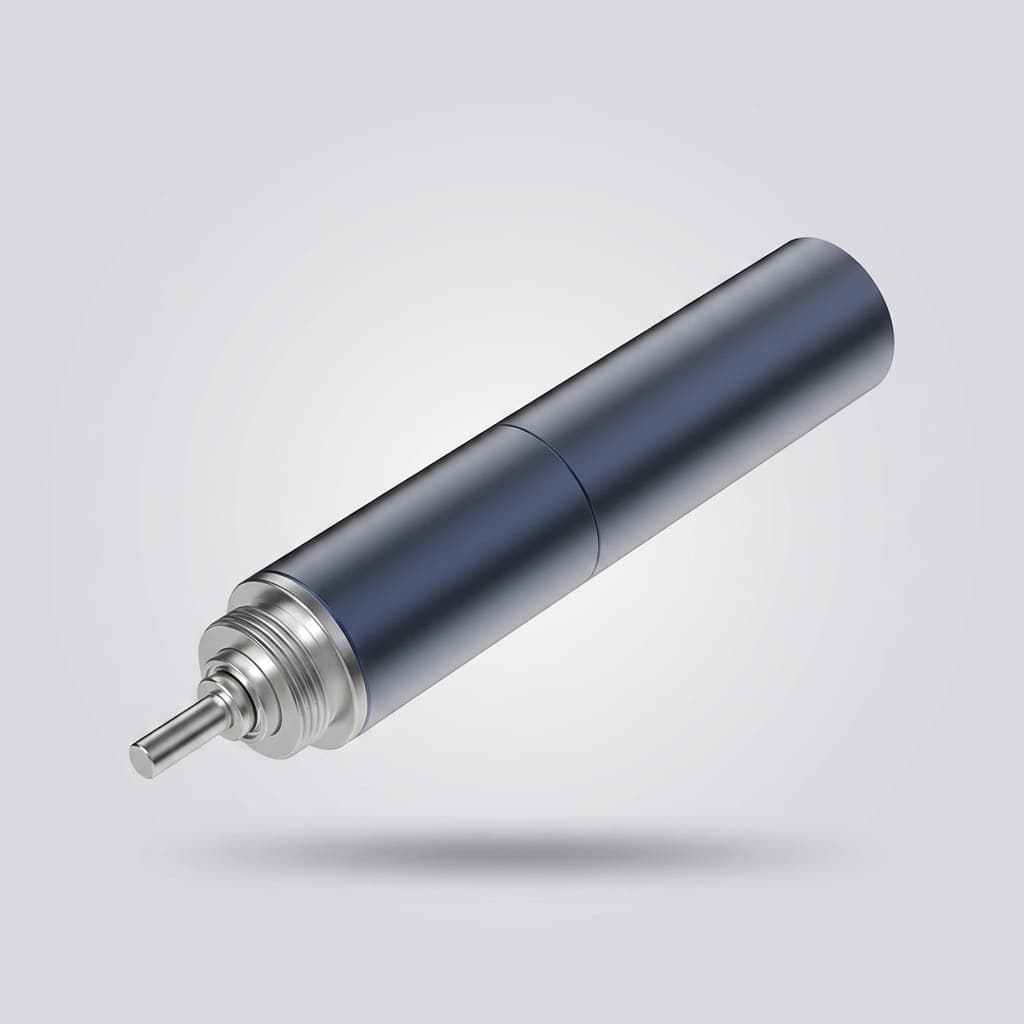
Product illustration only; it does not certify the internal roller arrangement, alloy, tolerances or supplier production process.
7. Procurement & Sourcing Qualification Matrix
Use this matrix to request evidence, then agree application-specific acceptance thresholds. The guide does not prescribe universal hardness, surface finish or endurance-cycle limits.
| Qualification Criterion | Ball Screw Evidence | Roller Screw Evidence | Audit & Verification Method |
|---|---|---|---|
| Material and heat treatment | Drawing-linked material and treatment specification | Specification covering screw, rollers and nut | Review traceable certificates and the agreed hardness/inspection records. |
| Lead accuracy | Standard, class and measured travel characteristics | Supplier-defined class/standard and measured characteristics | Compare lead-error reports at the specified travel and temperature. |
| Load and life calculation | Model rating, load spectrum and life calculation | Model rating and the manufacturer's family-specific method | Verify units, reliability assumptions, preload and duty factors. |
| Backlash and stiffness | Reversal error and force-deflection data | Reversal error and force-deflection data | Use the same loads, supports, measurement locations and temperatures. |
| Return or timing components | Ball-return arrangement and speed limits | Roller synchronization arrangement and speed limits | Review drawings and performance under agreed acceleration profiles. |
| Short-stroke endurance | Lubricant and test data for the proposed duty | Lubricant and test data for the proposed duty | Record stroke, frequency, load, temperature, failures and teardown findings. |
| Factory acceptance testing (FAT) | Drag torque, usable stroke and traceability | Drag torque, usable stroke and traceability | Agree sample size or inspection coverage, thresholds and retained logs. |
8. Actuator Selection & Procurement Checklist
Before a purchase order or interface freeze, assign an owner and an evidence record to each item:
- 1. Linkage sizing: Map actuator force and speed over the complete joint range, including near-singular poses and off-nominal loads.
- 2. Overload margin: Agree static safety factors, buckling/end-connection checks and impact tests for the maximum equivalent load. A generic safety factor cannot guarantee damage-free falls.
- 3. Inverted vs. standard fit: Compare complete retracted/extended CAD and confirm the motor, bearing, rod and seal interfaces.
- 4. Lead and inertia: Calculate motor torque/rpm and acceleration demand; check the actual rotating inertia and motor operating envelope.
- 5. Side-load isolation: Provide guides and joints that route transverse forces and moments through a designed load path rather than the screw contacts.
- 6. Lubrication: Obtain a duty-specific grease, seal, temperature and maintenance specification with supporting test evidence.
- 7. Feedback: Define output-position or force sensing, calibration and acceptable reversal error for the intended control strategy.
- 8. Thermal behavior: Verify continuous force-speed capability, temperature limits and drag after thermal stabilization.
- 9. Tooling and delivery: Record NRE, ownership, inspection scope, quote validity and first-article/pilot delivery milestones.
- 10. Second source and power loss: Confirm interface compatibility, requalification requirements and brake/holding behavior before approving an alternate assembly.
9. When Are Ball Screws Still the Smarter Choice?
Keep a ball screw in the comparison whenever a catalog or custom model meets the application's load spectrum, life and packaging requirements. Useful screening cases include:
- Lower-demand upper-body axes: Evaluate a suitably sized ball screw where actual joint forces and package constraints permit it. The body region alone does not set the load.
- Hands, grippers and tendons: Compare miniature screw availability, lead, friction and drive integration against the required force and speed.
- Early controls prototypes: An available ball screw may simplify procurement, provided the prototype has verified load limits and appropriate operating constraints. Slow indoor walking does not itself establish durability.
- Cost-sensitive service platforms: Compare complete actuator cost and duty-cycle energy consumption. Neither the absence of heavy ground impacts nor a nominal screw efficiency removes the need for overload and thermal checks.
Select the least complex candidate that passes the same evidence requirements; do not require a roller screw solely because it appears in another robot's architecture.
10. Frequently Asked Questions (FAQ)
Q1: Can an oversized ball screw match a roller screw's lifespan?
A: It may meet the same required application life, but diameter alone cannot establish equivalence. Compare named models using their own rating/life methods and the same duty spectrum. Include nut length, mass, inertia, supports and usable envelope before accepting or rejecting a larger ball screw.
Q2: What backlash should we expect from an inverted planetary roller screw?
A: There is no universal IPRS backlash value. Ask for axial clearance or reversal error at specified loads and temperatures, the preload method and starting/running torque. A “zero backlash” claim still requires a measurement definition and a wear/endurance acceptance criterion.
Q3: How do we prevent side loads from damaging the screw?
A: Use a designed guide/bushing arrangement and suitable rod-end joints to carry transverse forces and bending moments through the actuator structure. Include guide friction and misalignment in validation. Anti-rotation guidance alone does not establish an adequate radial-load capacity.
Q4: Are micro-leads exclusive to roller screws, and are they always better?
A: No. THK's diameter/lead tables include small-lead ball screws, while the available combination depends on the model. As the worked example shows, reducing lead lowers steady motor torque but raises rpm at the same linear speed. Check speed limits, drag, thermal duty and reverse-drive behavior before selecting it.
Q5: How often should a humanoid screw actuator be regreased?
A: Use the supplier's interval for the validated load, travel, oscillation, temperature, contamination and seal conditions. Obtain the grease type, quantity, service procedure and inspection triggers. This guide has no endurance evidence supporting a universal hours-based interval or lifetime-lubrication promise.
Q6: What are prototype and production lead times in 2026?
A: A reliable answer requires a dated quotation for the selected drawing, quantity, tooling and acceptance plan. Ask for first-article and repeat-production milestones separately, plus quote validity and capacity assumptions. This guide does not establish an industry-wide delivery range.
11. Conclusion & Sourcing Next Steps
Shortlist ball screws, standard roller screws and inverted roller screws against the same joint duty and assembled package. Use model-specific load/life evidence to decide whether a roller screw's integration or capacity advantages justify its sourcing and validation effort. IPRS is a packaging option, not a guarantee against shock damage or an automatic requirement for bipedal locomotion.
Before requesting quotations, prepare the drawing revision, joint force-speed spectrum, stroke, retracted envelope, life target, thermal conditions, sensing/brake requirements and sample/annual quantities. Mark unknown inputs so suppliers can identify the missing decisions.
Ready to compare candidates for your humanoid program?
- Review the Humanoid Linear Actuator Product Overview for integration and sourcing requirements.
- Check the Bipedal Leg Joint Actuator Guide for application context.
- Compare lower-body options in the High-Torque Leg Actuator Modules section.
- Bring the completed checklist and duty profile to our Linear Actuator RFQ & Engineering Review. Request candidate-model evidence and application validation before design approval.
Sources & References
Sources checked on October 26, 2026. Manufacturer pages describe their own offerings; they are not independent comparative tests. The research reference below was checked at abstract level only. None of these sources establishes this guide's own hardware test results, global prices, delivery-time averages or cross-brand lifetime multipliers.
- Rollvis SA: Planetary Roller Screw Products & Solutions. Manufacturer overview of planetary, inverted, recirculating and differential screw families; supports the architecture comparison.
- THK: Selecting lead · Selecting a shaft diameter. Manufacturer tables showing ball-screw diameter/lead combinations, including small-lead options; not a matched roller-screw performance comparison.
- Lin et al., ICIRA 2025 / Springer Nature: Humanoid Locomotion with Roller Screw-Driven Knee Joints: Design, Control, and Deployment, first online October 27, 2025, pp. 497–508. Abstract-level evidence of roller-screw knee modeling and hardware deployment; not a general shock, lifetime or sourcing benchmark.
- LTK Lineartechnology: Inverted Planetary Roller Screws. Manufacturer description of customized inverted screws, humanoid applications and thread-grinding capability; no audited prices or delivery guarantees used here.
Author

Categories
Buyer path
After Reading
Use the guide to choose the next sourcing action.
Convert the guide into application-risk notes before asking for samples or controlled files.
Send prototype contextCarry accepted article checklists into sample release, pilot supply, and OEM documentation control.
Prepare OEM sample plan1. Why Linear Actuation in Humanoids?A reproducible lead, torque and speed screen2. Contact Mechanics: Ball Contacts vs. Threaded Roller Contacts3. Standard Planetary Roller Screw vs. Inverted Planetary Roller Screw (IPRS)Standard planetary roller screw (PRS)Inverted planetary roller screw (IPRS / reverse roller screw)Packaging trade-offs to verify4. Engineering Comparison: Ball Screw vs. PRS vs. Inverted PRS5. Critical Failure Modes in Humanoid Service1. Permanent indentation and impact overload2. Roller synchronization and ball-return damage3. Lubrication under short-stroke oscillation4. Thermal preload and alignment changes6. Manufacturing Economics & Sourcing Realities in 2026The grinding and inspection questionsBuild a comparable sourcing quote7. Procurement & Sourcing Qualification Matrix8. Actuator Selection & Procurement Checklist9. When Are Ball Screws Still the Smarter Choice?10. Frequently Asked Questions (FAQ)Q1: Can an oversized ball screw match a roller screw's lifespan?Q2: What backlash should we expect from an inverted planetary roller screw?Q3: How do we prevent side loads from damaging the screw?Q4: Are micro-leads exclusive to roller screws, and are they always better?Q5: How often should a humanoid screw actuator be regreased?Q6: What are prototype and production lead times in 2026?11. Conclusion & Sourcing Next StepsSources & References
More Posts
Engineering NotesProcurement Guides
Axial-Flux vs. Radial-Flux Motors for Humanoid Actuators: A 2026 Sourcing Guide
Compare axial-flux vs radial-flux motors for humanoid actuators in 2026: torque density, thermal limits, tooling cost, joint fit, and RFQ sourcing checks.

Product Engineering
Sourcing Humanoid Robot Actuators in 2026: Overcoming Pre-Modular Bottlenecks
A 2026 procurement guide for humanoid robot actuators: qualify modules, manage pre-modular supply risk, and compare custom vs. integrated sourcing paths.
Engineering NotesProduct Engineering
Humanoid Actuator Thermal Management: Sourcing for Continuous Torque
A 2026 procurement guide to thermal derating in humanoid robot actuators. Learn how to evaluate cooling architectures and source for continuous, rather than just peak, torque.